
Part 1: The Paradox of Doing Nothing
In a world that celebrates “hustle culture” and the obsession with being constantly busy, we often overlook a fundamental truth: Doing nothing is always faster than doing something. This isn’t a lazy man’s manifesto; it is a mathematical reality. In the world of software engineering, there is a famous saying: “No code is faster than no code.” It means that the most efficient program is the one that doesn’t have to run at all. Every line of code you write is a liability—it can break, it requires maintenance, and it takes up space. Similarly, in our daily lives, every meeting you cancel, every irrelevant task you delete, and every “small favor” you decline is a direct deposit into your bank of time.
Yet, most of us live in a state of chronic “Yes.” We say yes to coffee dates we don’t want to attend, projects that don’t align with our goals, and obligations that drain our spirit. We treat our time like an infinite resource, but the reality is that your time is a zero-sum game. To say yes to one thing is, by definition, to say no to everything else you could have done with those hours.
Part 2: The Psychology of the “Yes” Trap
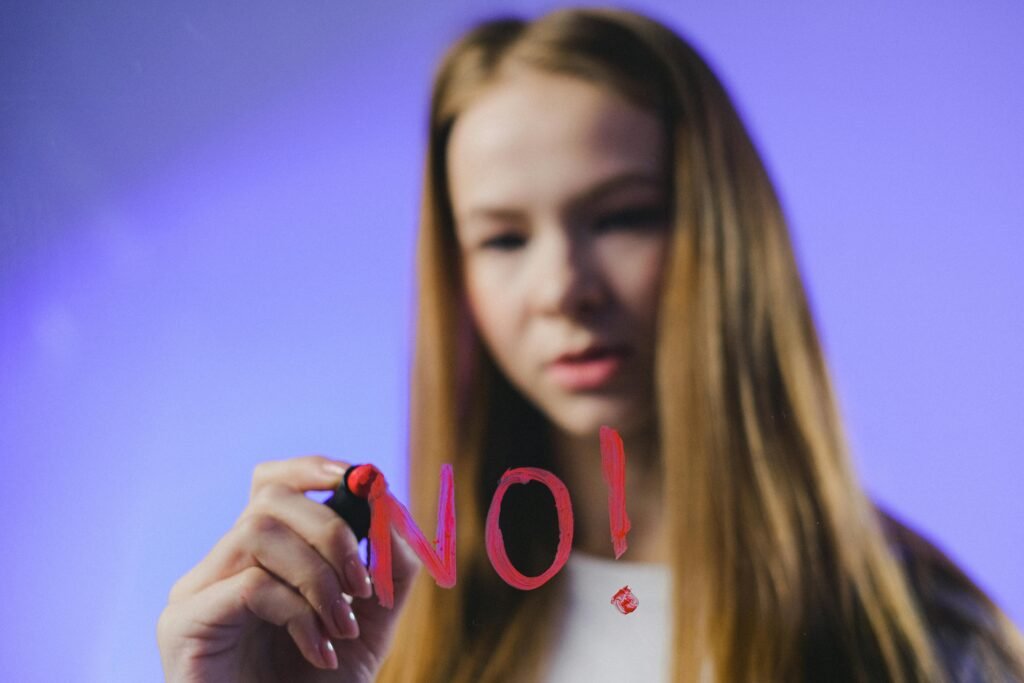
Why is it so hard to utter that simple, two-letter word: NO?
As human beings, we are hardwired for social connection. For thousands of years, being cast out of the tribe meant certain death. This evolutionary baggage manifests today as a fear of social friction. We say yes because:
The Politeness Trap: We don’t want to be perceived as arrogant or unhelpful.
The Fear of Disappointment: We value other people’s temporary feelings over our own long-term goals.
The Relationship Risk: We worry that a “no” today will burn a bridge tomorrow.
But here is the irony: People who say “yes” to everyone often end up being the least reliable. When you are overcommitted, your quality of work drops, you miss deadlines, and you show up exhausted. By trying to please everyone, you end up serving no one—least of all yourself.
Part 3: The Asymmetry of Choice
To master productivity, you must understand the fundamental difference between these two words. They are not equal.
“No” is a decision. It is a surgical strike. When you say no, you are rejecting one single option. Your future remains wide open.
“Yes” is a responsibility. When you say yes, you are choosing one path and, in doing so, you are closing the door on a thousand other possibilities for that period of time.
Think of it this way: “No” is a form of time insurance. It protects your future self from the clutter of the present. “Yes” is a debt that you will have to pay back with your most precious currency: your life.
Part 4: The Opportunity Cost of Being “Nice”
When we talk about productivity, we usually talk about apps, calendars, and to-do lists. But productivity is less about managing your time and more about managing your focus. Every time you agree to a “quick chat” that isn’t aligned with your mission, you aren’t just losing 15 minutes. You are losing the “switching cost”—the mental energy it takes to move from deep, meaningful work to shallow chatter and back again.
Economists call this Opportunity Cost. In the context of your life, it is the hidden price tag on every “Yes.” If you spend your morning responding to non-urgent emails because you want to be “responsive,” the price you pay is the book you never wrote, the business strategy you never polished, or the workout you skipped. We often choose the path of least resistance (saying yes) because the cost is invisible at that moment. You don’t feel the loss of your dream in a 10-minute phone call, but those calls, over a decade, are exactly what bury dreams.
Part 5: The “Hell Yeah” or “No” Framework
To reach a level of elite productivity, you need a filter. One of the most effective filters was popularized by entrepreneur Derek Sivers. He argues that if you are feeling “overwhelmed” or “too busy,” it’s because you are saying yes to things that are just “okay.”
The rule is simple: If you don’t feel like saying “Hell Yeah!” about something, then say “No.”
Most of us live in the “in-between” zone. We get an invite to a seminar, and we think, “Well, it might be interesting,” or “I guess it couldn’t hurt.” That is a trap. “It couldn’t hurt” is the slow poison of a productive life. When you use the “Hell Yeah” filter, you clear out the clutter. You realize that most things in life are noise. By ruthlessly cutting out the “7s” and “8s” out of 10, you finally leave space for the “10s.”
Part 6: Why “No” is the Tool of the Greats
If you look at the most successful people in history, their secret wasn’t that they worked more hours; it’s that they guarded their hours with ferocity.
- Steve Jobs famously said that he was as proud of the things Apple didn’t do as he was of the things they did. Innovation, he argued, was saying “no” to a thousand good ideas so you could focus on the one great one.
- Warren Buffett once remarked, “The difference between successful people and really successful people is that really successful people say no to almost everything.”
This isn’t because they are mean or anti-social. It’s because they understand that focus is a finite resource. You only have a few hours of “peak brainpower” every day. If you give those hours away to someone else’s agenda, you are effectively bankrupting your own future.
Part 7: The Art of the Elegant Refusal (How to say No)
The biggest hurdle to saying no is the fear of being “that guy”—the jerk, the uncooperative teammate, the cold friend. But saying no is a skill that can be practiced with grace. Here is how to do it without burning bridges:
- The Soft Refusal: “Thank you for thinking of me. While this sounds like a great project, I’m currently at capacity and can’t give it the attention it deserves.” (This frames your ‘no’ as a commitment to quality).
- The “Not Now” Refusal: “I’m focused on a major deadline until the end of the month. Can we check back in then?” (This protects your current deep-work season).
- The Referral: “I’m not the best person for this right now, but have you talked to [Name]? They are an expert in this.” (This provides value without you doing the work).
Being “Human” means being honest. People actually respect a clear “No” more than a flaky, half-hearted “Yes” that ends in a late delivery or a cancelled plan.
#Productivity
#Personal Development